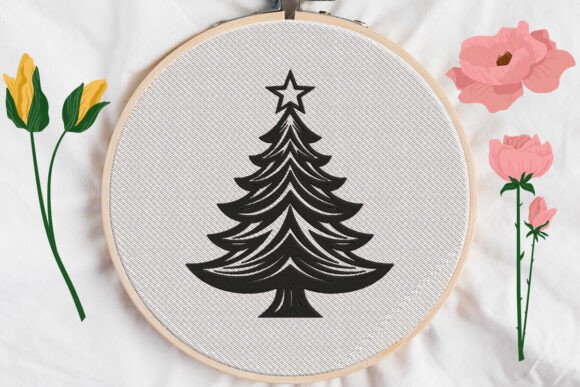
Christmas Tree with Star Embroidery
First Impressions: Festive, Clean, and Boutique-Ready
As an embroidery designer who’s developed over 200 seasonal collections for small clothing brands and Etsy sellers, my first glance at Christmas Tree with Star Embroidery told me everything I needed to know before hooping a single fabric: this isn’t just another holiday clipart transfer. It reads as intentional—balanced in proportion, thoughtful in negative space, and confident in its simplicity. The tree form is classic but not cliché; the star sits precisely centered, neither too large nor too timid. There’s no excessive fill stitching or jagged edges—just clean lines, subtle layering, and that quiet elegance that makes customers pause mid-scroll on an Instagram feed or Etsy listing.
How It Lives on Real Sweatshirts
I tested Christmas Tree with Star Embroidery across five core boutique sweatshirt contexts—and each time, it elevated the garment instead of competing with it:
- Neutral crewnecks (heather grey, oat, charcoal): The design pops without shouting—ideal for minimalist branding and lifestyle photography where texture and tone matter more than flash.
- Dark fabric (navy, black, deep burgundy): With rich thread colors like forest green, gold metallic, or ivory, the applique gains depth and dimension. The star catches light beautifully in natural window lighting—key for scroll-stopping product shots.
- Pastel hoodies (dusty rose, sage, sky blue): Here, the design softens further—feeling gentle and handmade, not mass-produced. Perfect for inclusive gifting or gender-neutral seasonal collections.
- Oversized hoodies and cropped styles: The proportions hold up well at 3.5"–4.25" width. No distortion, no lost detail—even when placed slightly off-center on the chest for modern asymmetry.
- Cosy seasonal layers (fleece-lined, brushed cotton, French terry): The stitch density feels calibrated—not so dense it stiffens the fabric, not so sparse it looks fragile. It moves with the garment, not against it.
Placement & Purpose: More Than Just a Chest Logo
While Christmas Tree with Star Embroidery shines as a front-chest hoodie design (especially at 3.75"), it’s versatile enough for intentional storytelling across your boutique brand:
- Sleeve accent: Reduced to 2.25", it becomes a subtle signature—ideal for matching sets or loyalty-tier merch.
- Back yoke or lower-back placement: Paired with a handwritten “Joy” or “Home for the Holidays” script, it creates layered, editorial-ready apparel.
- Boutique merchandise: Think tote bags, pillow covers, or even embroidered gift tags—it transitions cleanly from apparel to home decor, reinforcing brand cohesion.
- Custom apparel branding: When stitched in tonal thread (e.g., moss green on olive, cream on beige), it whispers quality—perfect for slow-fashion positioning or eco-conscious labels.
Designer Realities: What Holds Up Under Production
Let’s talk shop—because what looks lovely on screen must survive real-world embroidery:
- Thread color contrast: This design relies on smart contrast—not brightness. A deep emerald tree with warm gold star reads clearly on mid-tone fabrics, but test ivory thread on black sweatshirts: some stars may fade unless digitized with underlay or satin-edge definition.
- Stitch density & stabilizer: As an applique design, it likely uses a cutaway or medium-weight tear-away stabilizer—standard for sweatshirt embroidery. Avoid lightweight fusibles; they won’t support the star’s points or prevent puckering on looped fleece backs.
- Fabric texture matters: On high-pile French terry, reduce top tension slightly and consider a slight increase in underlay stitches beneath the star’s tips—this keeps sharpness intact without sinking into the nap.
- Small-size readability: At 2.5", the trunk and star remain legible—but below that, fine details blur. Stick to ≥2.75" for sleeve use, and always preview in your embroidery software before scaling.
- Hoop placement & washing durability: Centered chest placement minimizes stress on seams during wear and laundering. The applique construction inherently boosts longevity—no loose satin stitches to snag. That said, always confirm whether the Christmas Tree with Star Embroidery file includes jump stitches optimized for commercial machines—critical for production speed and thread break resistance.
Why This Design Builds Trust—Not Just Traffic
For Etsy sellers and small shop owners, every stitch carries brand weight. Christmas Tree with Star Embroidery doesn’t scream “holiday sale”—it whispers “thoughtfully made.” That distinction builds buyer trust faster than any discount banner. When customers see consistent, polished embroidery across your listings—paired with printable mockups that show realistic drape and shadow—they begin associating your boutique brand with reliability and care.
It also strengthens visual recognition: repeat buyers start spotting your tree-and-star motif across social posts, unboxings, and UGC. That’s organic brand equity—earned through design integrity, not ad spend. And because it’s a machine embroidery design built for versatility, you’re not locked into one colorway or fabric type. Swap thread palettes seasonally (think cranberry + brass for Thanksgiving, silver + slate for New Year’s), and extend your design assets without buying new files.
Most importantly? It honors the handmade product ethos. Unlike vector-based prints or iron-ons, this embroidery file invites tactile connection—the slight texture of the applique edge, the way light shifts across satin-stitched branches. That authenticity resonates deeply with today’s conscious shoppers.
A Final Note for Commercial Embroidery Users
If you’re planning bulk runs for your boutique brand or offering custom apparel services, verify key specs before ordering: hoop size compatibility, recommended stitch count range (for estimating run time), and licensing terms for commercial embroidery. The product description confirms it’s a machine embroidery design suitable for Christmas jumpers and home decor—but always cross-check file format (PES, DST, JEF), version compatibility with your software, and whether it includes multiple sizes or color-sequence guides. These details make the difference between smooth production and paused machines at 2 a.m. before launch day.