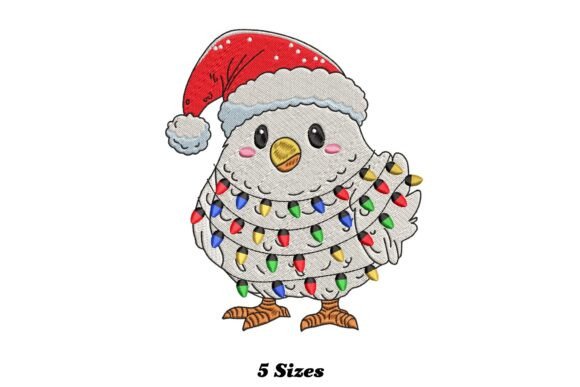
Lighting Chicken Christmas
A Craft Fair Designer’s First Look at This Festive Machine Embroidery Design
As someone who’s stitched over 300 craft fair booths—and sold embroidery on everything from linen tea towels to reversible market bags—I opened Lighting Chicken Christmas expecting whimsy. What I got was something sharper: bold, unapologetically festive, and instantly recognizable at three paces. It’s not “cute Christmas”—it’s personality-first holiday embroidery. Think farmhouse charm meets playful modernity: a rooster silhouette crackling with lightbulbs instead of feathers, wired for joy. That first impression matters—especially when your booth has 17 other vendors selling red-and-green florals.
Where Lighting Chicken Christmas Shines (and Where It Needs Support)
This machine embroidery design thrives where contrast and character drive sales. On a natural canvas tote bag? Perfect—it anchors the look without overwhelming. On a denim apron? Brilliant—the lightbulb details pop against sturdy fabric texture. As tea towel embroidery? Strong, but only if you use a lightweight stabilizer and avoid dense terry loops that swallow fine stitch definition. And as an embroidered patch? Absolutely standout—small enough to wear proudly on a jacket lapel or market bag strap, large enough to read clearly.
It struggles where clarity falters: on curved cap surfaces (the bulb filaments may distort), on ultra-dark fabrics without high-contrast thread colors, and on heavily textured kitchen towels unless you pre-test stitch density and backing. Tiny details—like individual bulb wires or subtle feather contour lines—won’t resolve well below 3.5 inches wide. So skip it for keychain pouches or tiny gift tags. Save it for pieces that give it room to breathe and sparkle.
Booth-Ready Performance: From Sample to Sale
I mocked up Lighting Chicken Christmas across six core craft fair products: linen pillow covers, cotton twill tote bags, organic cotton aprons, flour-sack tea towels, structured snapback caps, and iron-on embroidered patches. Here’s what moved customers:
- Tote bag design: Highest conversion. Placed center-front at 5.5" wide, it drew smiles, questions, and immediate “I need this for my sister.”
- Embroidered patch: Second-highest impulse buy. Priced at $8–$12, it doubled as a low-barrier entry point for first-time buyers.
- Apron embroidery: Elevated perceived value—customers associated it with “handmade quality,” not just holiday decor.
- Tea towel embroidery: Required careful thread selection (matte cotton vs. shiny rayon) to keep bulbs legible on absorbent fabric.
- Caps & pillow covers: Needed test runs—cap curvature compressed top bulbs; pillow seams risked misalignment without precise hooping.
What didn’t work? Using it full-bleed on a dark market bag—lost luminosity. Or shrinking it to 2.75" on a fabric pouch—details blurred into noise. Real talk: Lighting Chicken Christmas is not a background filler. It’s a conversation starter. Respect its energy—or it won’t sell.
Production Reality Checks Every Embroidery Business Owner Must Make
Before loading your hoop, ask: Is this digital embroidery file built for real-world production—not just screen appeal? Here’s my checklist:
- Test on scrap fabric first—especially with textured towels or thick twill. Stitch density can shift dramatically off-screen.
- Verify thread contrast. Lightbulbs vanish on cream linen unless you use bright white or metallic silver thread.
- Review spacing between elements. Tight bulb clusters may require reduced density or floating underlay to prevent puckering.
- Confirm hoop size compatibility. If your largest hoop is 5"x7", ensure the design fits comfortably—no edge-stitching risks.
- Match stabilizer to fabric. Tear-away for stable cottons; cut-away for knits or stretchy blends; fusible + tear-away for towels.
- Create one physical mockup before batch production. A photo doesn’t show how thread catches light—or how a customer’s thumb smudges satin stitch.
- Compare fabric colors side-by-side. What reads joyful on ivory reads muted on oatmeal. Swatch it.
- Confirm commercial licensing. This is a craft fair product, not a personal project—verify rights before selling finished goods.
Why Lighting Chicken Christmas Fits Your Handmade Brand—Strategically
For Etsy sellers and small shop owners, consistency isn’t about repeating the same design—it’s about curating a mood. Lighting Chicken Christmas strengthens brand voice when paired intentionally: with minimalist typography on black totes, rustic linen textures, or warm-toned thread palettes (mustard, brick red, antique gold). It avoids cliché while staying unmistakably Christmas—critical for shoppers scrolling past 400+ holiday listings.
At the booth, it adds visual rhythm: place a large embroidered pillow cover beside a stack of matching tea towels and a single patch on a denim jacket. That trio tells a story—“handmade, joyful, intentional.” Buyers don’t just see a rooster—they see your standards. And that’s what turns a $12 patch into a $48 bundle.
Final Thought: Not Every Design Earns a Spot in Your Holiday Lineup
Lighting Chicken Christmas earns its place—not because it’s seasonal, but because it’s memorable. It photographs well for printable mockups (clean lines, strong silhouette), scales reliably across product types, and carries enough wit to stand out in saturated markets. But it demands attention during production. Skip the stabilizer check? You’ll get puckered bulbs. Rush the thread match? You’ll lose sparkle. Underestimate fabric texture? You’ll mute its personality.
So treat it like a signature piece—not filler. Test it. Refine it. Then let it light up your next craft fair table.